If your Nakshatra is Jyeṣṭhā, it means that at the moment of your birth the Moon was moving through a stretch of sky marked by Antares (Alpha Scorpii), the brilliant red star that rests in the heart of the Scorpion and is many times larger than our own Sun. Jyeṣṭhā means "the eldest" or "the most ancient," and it is a star associated with seniority and ancestry. Its symbol is an earring, an umbrella, or a circular protective talisman — often read as the disc of Viṣṇu, which grants shelter and intellectual ability.
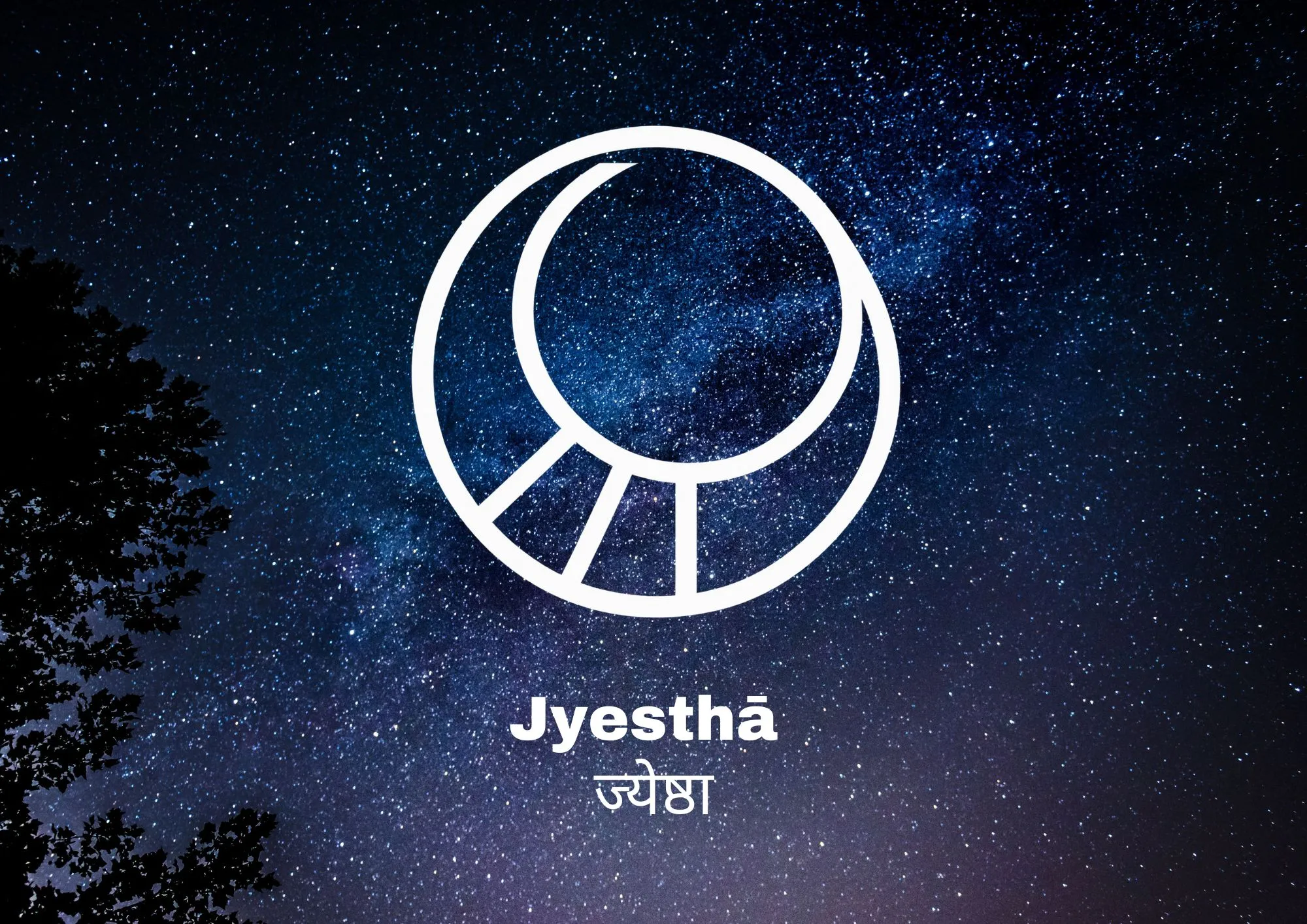
The ruling planet of Jyeṣṭhā is Mercury, associated with sharp intelligence, communication, and strategy. The deity presiding over this Nakshatra is Lord Indra, king of the gods, who lends the native a shrewd and courageous nature along with a taste for conquest and command. Mars, ruler of Scorpio, reinforces protection and activity, while Ketu, closely tied to this sign, brings the thread of transformation. Those born under this star have the capacity to achieve great things, but they must first learn to handle their inner conflicts and to exercise their power responsibly.
Now that you know your Moon is in Jyeṣṭhā, how about following the astrological transits of the week and going deeper as you read?
Subscribe on SubstackThose born under Jyeṣṭhā tend to be healthy, energetic, and magnetic, with a generous heart and a sincere seriousness that defines the personality. These are people who work according to their own conscience: because they listen little to others, they are often read as stubborn, when in truth they are simply doing what they believe to be right. The mind is sharp and grasps any subject immediately, but the rush to move forward ends up producing mistakes along the way. There is also a strong desire to attain or to become something, which drives the native to go to great lengths to impress — while remaining, underneath it all, clean-hearted and decent, someone who prefers to keep their own feelings well guarded.
Jyeṣṭhā natives stand up for the vulnerable and the underprivileged, and it is precisely their generosity and charity that establish their legitimate authority. The great caution here is the tendency to become overly preoccupied with recognition. They usually enter the professional world early and do not mind traveling far for it; being agile, they do everything swiftly and know the value of time very well. The years between 18 and 26 tend to bring some struggle, but it is exactly there that the experience which sustains the rest of the journey is forged.
Jyeṣṭhā favors a brilliant, analytical mind, the courage to take control, and a genuine instinct to shelter those at a disadvantage. Once they decide on something, they get it done — and outpace their competitors.
The intensity of Jyeṣṭhā can turn into irritability, self-importance, or the habit of hiding feelings and intentions. The thirst for recognition is the point that asks for the most vigilance.
Fields such as security, government, communication, media, engineering, surgery, and the occult tend to flow well under this energy — Jyeṣṭhā likes to be where the decision is made.
Jyeṣṭhā looks after the family and builds a solid support network, but work tends to create physical distance. The partner often exerts a strong influence — and that usually works in the native's favor.
The right side of the body, the region associated with Jyeṣṭhā, is usually linked to activity, strength, and action. A Nakshatra connected to this region tends to influence physical vitality and energy, the capacity to carry things out and reach goals, and it leaves the parts located on that side especially sensitive — the right hemisphere of the brain, the right eye, ear, arm, and leg. It is also the side of conscious action and decision-making, which translates into assertiveness and effectiveness in the world; some traditions add creative expression and intuition to it, the door through which insight and inspiration arrive.
Jyeṣṭhā divides into four padas that fine-tune this energy: the first (16º40' – 20º00'), in a Sagittarius navāṃśa and ruled by Jupiter, speaks of generosity; the second (20º00' – 23º20'), in Capricorn and ruled by Saturn, of responsibility; the third (23º20' – 26º40'), in Aquarius and also under Saturn, of altruism; and the fourth (26º40' – 30º00'), in Pisces and ruled by Jupiter, of sacrifice. The vowels associated with each are, respectively, No, Yā, Yī, and Yū — syllables traditionally used to name those born under each quarter.
Jyeṣṭhā natives tend to thrive both in high positions and in their own businesses, with particular strength in the security services, public service and administrative posts, journalism and correspondence, radio, television and hosting, acting and storytelling, music, engineering and management, philosophy and intellectual work, the fire brigade and disaster management, police detection and intelligence, the army and forestry service, shipping, telecommunications, athletics, and surgery. Family life tends to be stable, though marked by the distance that work imposes, and there is much to gain from avoiding excess intoxicants, which do not suit this constitution.
The Nakshatra shows your Moon — but it is the Ascendant that reveals how that energy takes shape in your body, your practical life, and your day-to-day choices. That only appears in the complete Birth Chart, calculated with your exact time and place of birth.
See how the Birth Chart worksThose born with the Moon in Jyeṣṭhā tend to have a sharp, analytical mind, the courage to take command, and a natural instinct to protect the vulnerable. They are resourceful, quick, and virtuous, learning fast and outpacing their competitors once they set their mind on something.
The more challenging side of Jyeṣṭhā shows up as an excessive concern with recognition, an intensity that turns into irritability, the habit of hiding feelings and intentions, and inner conflicts that ask to be resolved before power can be exercised responsibly.
No. The Moon's Nakshatra shows your emotional landscape, but the Ascendant, the planets in the houses, and the Dashas complete the picture. That is why reading the full Birth Chart is the recommended next step for anyone who wants to go deeper.
It is worth noting that these characteristics offer a general view of the astrological influences of this Nakshatra. A person's complete astrological profile involves a combination of factors, such as the position of the other planets in their natal chart. Consulting a professional astrologer can offer a more detailed and personalized understanding of how a Nakshatra affects someone's life. Another important aspect of your Nakshatra is knowing which Pada it falls in: with that information we can also analyze compatibility with other constellations and even the motivation each Nakshatra carries for acting in the world.
The Nakshatra is a window — the Birth Chart is the whole house. With your exact date, time, and place, it reveals your Ascendant, your gifts, your karmic challenges, and the life phase you are in right now.
Book my Birth ChartVedic Astrology tunes you in to the answers you are looking for!
If this is your first contact with Vedic astrology, the recommendation is to start with the Birth Chart. This chart is the foundation of astrology and reveals your astrological configuration at the exact moment of your birth, pointing to your potential, your challenges, and the main aspects of your personality. This interpretation can help you deeply understand your personal characteristics, your life journey, and the impact of the planets on your path. In the session, which can be online or in person and includes a detailed PDF, you get an overview of the main elements of your chart and receive guidance on applying that knowledge day to day.
See details and bookOnce you already have your Birth Chart, it is worth doing the Solar Return every year, ideally close to your birthday. This chart considers the position of the Sun at its annual return and reveals the specific energies and challenges of the year. With it, you can understand the influences at work in each month, planning ahead to make the best use of those energies and reach your goals. The interpretation session, which also includes a PDF, offers insight into areas of growth and the most favorable moments for important actions.
See details and book